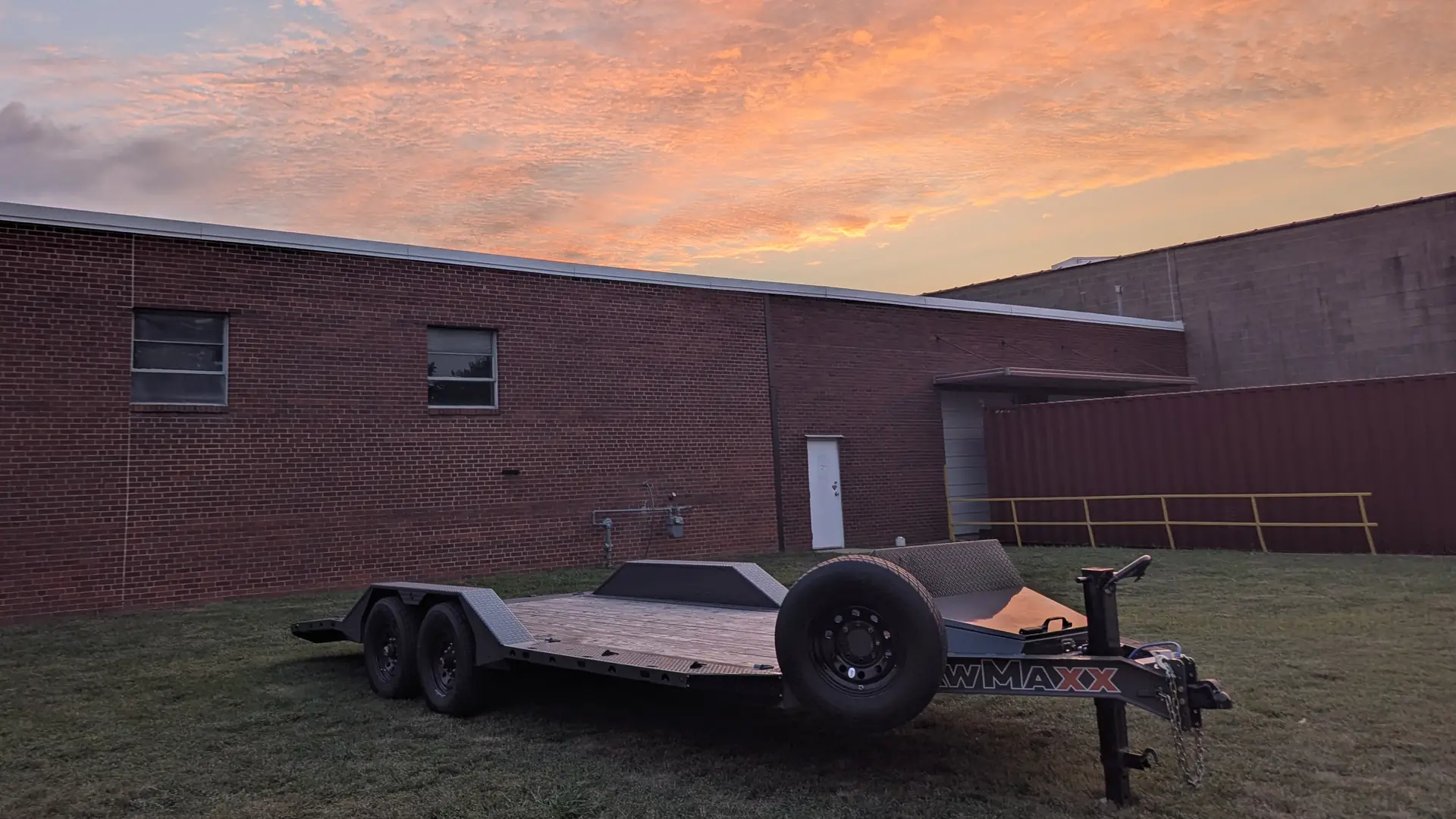
How to Load and Tie Down a Car on a Car Hauler Trailer
To load a car on a car hauler, hitch the trailer to a properly rated truck on level ground. Then drive or winch the car on slowly with a spotter, park it with about 60% of its weight ahead of the trailer axles, and strap all four corners so it can't move in any direction. Check the straps again after the first few miles. Most loading problems come from skipping the tow-vehicle check or rushing the tie-down.
This guide uses the 20' Car Hauler Trailer from KC Trailer Rentals as the example. Its trailer page lists it with a 20' × 102" deck, 83 inches between drive-over fenders, welded D-rings, stake pockets and X-track, and a 12,000 lb winch already mounted. The loading steps are general guidance that applies to most car haulers.
Before you start: check the truck, not just the car
The car hauler has a 14,000 lb GVWR on dual 7,000 lb torsion axles and a 10,000 lb payload. It requires a 3/4-ton or 1-ton truck with a 2 5/16 inch ball, and the coupler is adjustable.
That rules out a lot of vehicles people try to use, like small four-cylinder pickups and many older half-tons. Add the weight of the car you're hauling to the trailer and confirm your truck's tow rating (in the owner's manual) covers the total. For a long highway trip, give yourself more margin, not less.
Step 1: Hitch up on level ground
Park the truck and trailer straight and on level ground. Make sure the coupler is fully seated on the ball and latched, cross the safety chains under the tongue and attach them to the truck, then plug in the lights and test the brake lights and turn signals with a helper before loading.
Step 2: Line up the car
Clear the deck and line the car up straight, usually engine end forward, since the engine is the heavy end on most cars. Check a wide car against the 83 inches between the fenders. Have a spotter stand to the side, never directly in front of or behind the car. If you're loading a very low car, call or text (816) 339-8939 first to confirm it will clear.
Step 3: Drive it on, or winch it on
For a running car, drive up slowly at a steady crawl and follow your spotter. Avoid sudden throttle or braking. For a non-running car, use the mounted 12,000 lb winch. Hook the line to a solid recovery point on the car, keep the car in neutral with a spotter steering, and walk it up the deck under winch power. Keep everyone clear of the winch line while it's under load.
Step 4: Position the car for proper tongue weight
As general guidance, place about 60% of the vehicle's weight ahead of the trailer axles. That usually puts tongue weight in the commonly recommended range of 10–15% of the total loaded trailer weight. Too little tongue weight (car too far back) is a classic cause of trailer sway, and too much (car too far forward) overloads the rear of the truck. If the back of the truck sags noticeably or the tongue lifts, reposition before you strap down.
Step 5: Set the car
Put the car in park (or in gear for a manual), set the parking brake and turn it off. Close the windows and secure anything loose inside.
Step 6: Tie down all four corners
Use the straps and tie-downs included with the rental, anchored to the trailer's welded D-rings, stake pockets or X-track. Standard practice is one strap per corner: front straps pull forward and out, rear straps pull back and out, so the car can't move forward, backward or sideways. Strap to the tires or to solid frame tie-down points, not to suspension arms, tie rods, brake lines or exhaust parts. Tighten evenly until the car is snug, and tuck loose strap ends so they don't flap on the highway.
Step 7: Re-check after a few miles
Straps can settle as the car moves on its suspension. Pull over somewhere safe after the first few miles and re-tighten, then check again at each stop. Drive slower than normal, leave extra stopping distance and take turns wide.
Unloading
Reverse the steps on level ground. Remove the straps only after the truck is parked and the trailer is stable. Back a running car off slowly with a spotter. Ease a non-runner down under winch control. Don't just let it roll.
Current rates: 20' Car Hauler $160/day. The deposit is $160 (one day's rate). Multi-day discounts are 5% off 3+ days, 10% off 5+ and 15% off 7+, applied automatically. Delivery is $3 per mile within 100 miles of the lot. Renters must be 21+ with proof of valid personal auto insurance for the tow vehicle.
FAQ
What truck do I need to tow the 20' car hauler? The 20' car hauler has a 14,000 lb GVWR and requires a 3/4-ton or 1-ton truck with a 2 5/16 inch ball. Add the weight of the car you're hauling and confirm your truck's tow rating covers the total.
Can I load a car that doesn't run? Yes. The 20' car hauler has a 12,000 lb winch mounted and included. Hook the line to a recovery point, keep the car in neutral with a spotter steering, and winch it up slowly.
How many tie-down points should I use? Standard practice is to secure all four corners of the vehicle so it can't move forward, backward or sideways.
Are straps included with the car hauler? Yes. The winch, straps, tie-downs and spare tire come with the rental at no extra charge.
Rent the 20' car hauler in Kansas City
The car hauler is on the lot at 1010 Ellerbrook Rd, Kansas City, MO, which is open 24/7, or it can be delivered within 100 miles. See specs, live rates and open dates on the 20' Car Hauler page. Not sure your truck is up to it? Call or text (816) 339-8939 before you book.
